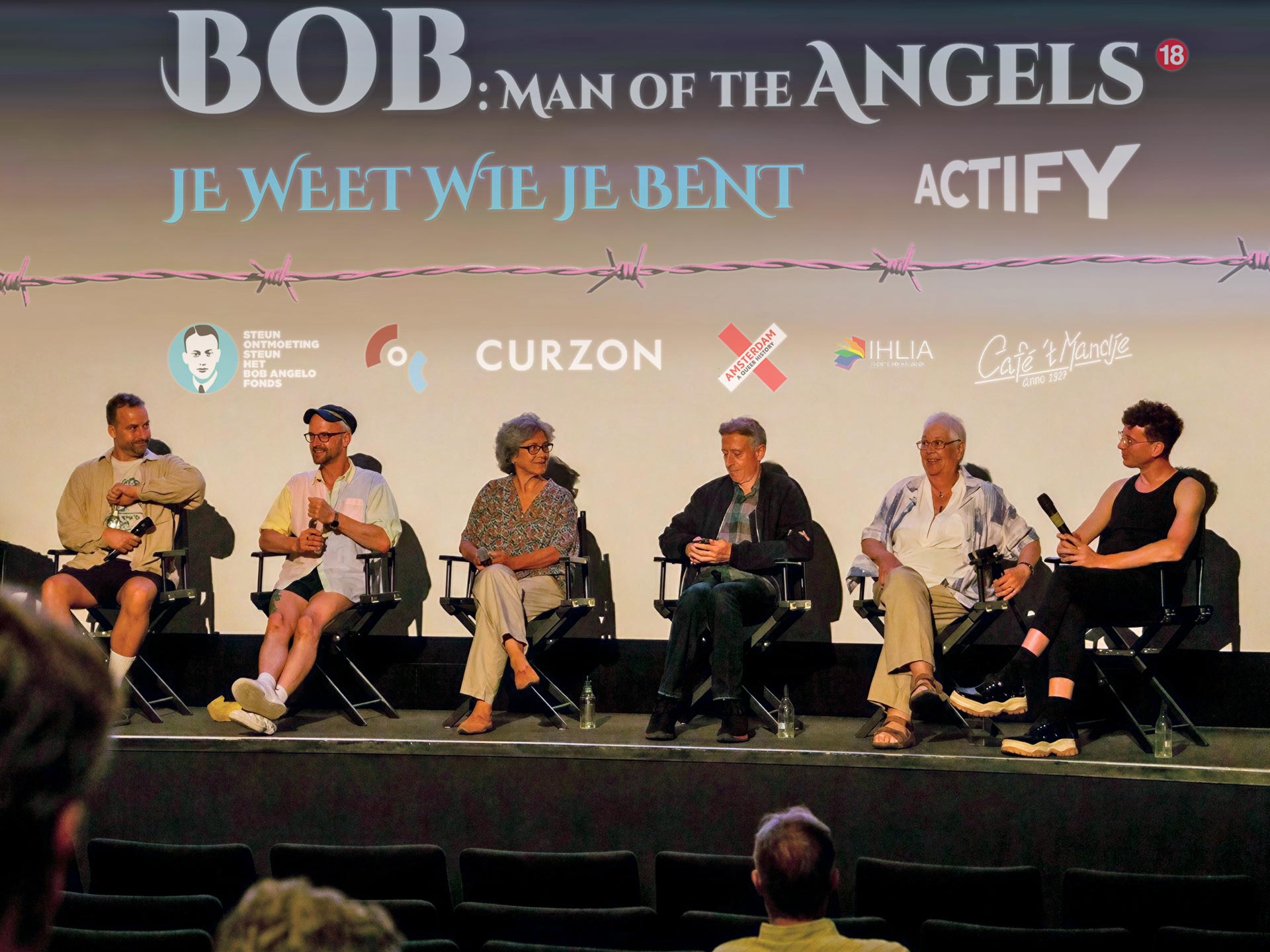
Some films ask you to watch.
Others ask you to remember.
Bob: Man of the Angels quietly asks something far more uncomfortable: what happens when history was never passed on in the first place?
There are documentaries that arrive burdened with statistics, timelines and talking heads determined to prove their own importance. Rob Falconer’s Bob: Man of the Angels couldn’t be further from that. It is, instead, an act of recovery. Patient, compassionate and profoundly moving, the film doesn’t simply tell the story of Niek Engelschman better known by his wartime pseudonym, Bob Angelo but uncovers an entire chapter of European queer history that many of us were never taught existed.
And perhaps that’s precisely the point.
Before Stonewall. Before Pride. Before rainbow flags became political footballs or marketing campaigns, there were people risking imprisonment, persecution and death simply to ensure that future generations might live a little more honestly. The tragedy isn’t merely what they endured. It’s how thoroughly many of their names disappeared.
Watching Bob: Man of the Angels feels less like watching a documentary than walking alongside someone discovering forgotten footprints beneath the streets of Amsterdam.
Falconer wisely avoids turning Bob Angelo into an untouchable saint. Instead, he allows him to emerge as something far more compelling a man of contradictions, humour, courage and relentless determination. Through historians, activists, archivists and those who knew him personally, Angelo becomes startlingly human. Not the founder carved into bronze, but the organiser who quietly built communities while fascism closed in around him.
The documentary’s greatest strength lies in understanding that history isn’t made by heroes alone.
It belongs equally to librarians preserving fragile magazines in underground archives, ageing activists remembering conversations from decades ago, museum curators holding a pair of scissors that suddenly become artefacts of resistance, and café owners whose establishments became sanctuaries long before anyone would have called them safe spaces.
One of the film’s most affecting revelations is just how organised queer resistance actually was during Nazi occupation. Popular history has often reduced LGBTQ+ lives during the Second World War to silent victims marked by pink triangles. Falconer gently but firmly dismantles that misconception.
Here are publishers destroying membership lists before the Nazis can seize them.
Here are illegal theatre performances staged in secret.
Here are forged identity papers, hidden weapons, underground meeting places and networks of astonishing bravery.
The documentary doesn’t diminish Jewish suffering by broadening the narrative. If anything, it enriches our understanding of resistance itself, showing how oppression rarely isolates one community from another. Queer history and Jewish history intersect throughout the film in ways that feel both deeply personal and politically urgent.
Visually, Amsterdam becomes more than a backdrop.
Its canals, cobbled streets and seemingly idyllic cafés carry ghosts.
Walking through the city after watching this film would surely feel different. Every bridge appears to hold another untold story. Every building becomes another witness.
That emotional geography is perhaps the documentary’s quiet triumph.
There is no bombastic score demanding tears. No manipulative editing insisting upon outrage. Instead, Falconer trusts the audience to sit with uncomfortable silences. The camera lingers where most documentaries would cut away, allowing places themselves to become storytellers.
Among the film’s most unforgettable figures is Bette van Beeren, the fearless owner of Café ‘t Mandje. Her story alone could sustain an entire feature film. Tough, irreverent, endlessly charismatic and quietly heroic, she embodies everything the documentary wishes to say about resilience. She cut men’s ties from around their necks as trophies, hid resistance weapons in her attic, sheltered vulnerable people and somehow managed to outwit Nazi occupiers without ever losing her mischievous spirit.
She isn’t presented as extraordinary because she was fearless.
She’s extraordinary because she was frightened and carried on regardless.
That distinction matters.
Equally compelling is the documentary’s relationship with memory itself.
Throughout the film runs an undercurrent of grief not only for lives lost, but for stories neglected. One interviewee reflects on growing up learning everything about the persecution of Jewish people while hearing almost nothing about queer resistance. It is a painfully familiar observation. Entire generations inherited partial histories, leaving invisible gaps where countless lives should have been remembered.
Bob: Man of the Angels attempts to fill some of those gaps.
Not with certainty.
With care.
The timing couldn’t feel more relevant.
As legislation targeting LGBTQ+ communities resurfaces across parts of Europe, and rights once assumed permanent suddenly appear fragile again, the documentary repeatedly reminds us that progress has never travelled in a straight line. Amsterdam itself—so often romanticised as an uncomplicated queer utopia is revealed as a city that earned its reputation through decades of struggle rather than inevitability.
History, the film quietly insists, can move backwards.
Which makes remembering an act of resistance in itself.
If there’s one criticism, it’s only that the wealth of fascinating figures occasionally threatens to overwhelm Bob Angelo’s own story. The documentary becomes so rich in personalities Frieda Belinfante, Willem Arondéus, Bette van Beeren, Benno Premsela and many others that Angelo sometimes feels less like the centre than the thread binding them together.
Then again, perhaps that is exactly who he was.
Not the loudest voice.
The one connecting everyone else.
Long after the credits roll, one line lingers, read by Dan De La Motte.
It is better to light one candle than curse the darkness.
The phrase appears almost in passing, yet it quietly becomes the documentary’s soul. Every archive preserved, every hidden meeting organised, every article published under a pseudonym, every safe space opened in impossible circumstances each was another candle.
And suddenly you realise something.
This isn’t really a documentary about Bob Angelo.
It’s about inheritance.
About the people who built a future they would never fully enjoy themselves.
About strangers who fought so that other strangers people they would never meet might one day walk through Amsterdam, London or anywhere else holding someone’s hand without fear.
Films rarely change history.
Occasionally, though, they restore it.
Bob: Man of the Angels is one of those rare films.
It doesn’t shout.
It remembers.
And in doing so, it quietly asks all of us to remember too.